Choose any destination that fits what you need now.
Program and course numbers are provided for easy reference. You can start with any program that fits your needs.
Getting Started with AILearn the essentials and develop enough confidence to begin exploring AI independently.4 coursesView coursesHide courses+
If conversational AI is new to you, start here. You will become familiar with the tool, learn how to ask for what you need, assess the answers you receive and make informed choices about where AI fits into your life.
No previous AI experience is required.
Course 1.1
Meet AI
Get comfortable with a conversational AI tool and explore what it can—and cannot—reasonably help you do.
You’ll learn to:
Use the tool’s main features and common functions
Recognize common AI capabilities and limitations
Identify useful starting points in your own life or work
Typical duration1 hour
Course 1.2
Meet Prompting
Learn how to turn a question, need or half-formed idea into a useful conversation with AI.
You’ll learn to:
Give AI the context and instructions it needs
Improve a response through follow-up questions
Correct misunderstandings and request useful changes
Typical duration1 hour
Course 1.3
Check if AI’s Results Are Correct
A polished answer is not necessarily an accurate or useful one. Learn how to examine AI’s work before relying on it.
You’ll learn to:
Judge whether a response fits your request
Recognize claims and details that need checking
Decide what to accept, revise, reject or verify
Typical duration1 hour
Course 1.4
Use AI on Your Terms
Bring the foundational skills together while developing personal rules for when and how you want to use AI.
You’ll learn to:
Protect personal, confidential and sensitive information
Complete a meaningful task from beginning to end
Continue exploring unfamiliar tasks without step-by-step support
AI for Everyday UseUse AI to communicate, learn, plan, solve problems, work with information and create useful results.9 coursesView coursesHide courses+
This program moves from basic familiarity to purposeful everyday use. Each course focuses on a type of activity rather than a particular AI product, so the skills can travel with you as tools change.
Take the courses that match your needs or combine them into a broader program.
Course 2.1
Using AI to Explore and Combine Information
Turn scattered or difficult material into information you can understand and use.
You’ll learn to:
Ask questions about documents, websites, notes and other material
Find key information, requirements, deadlines and action items
Combine sources while noticing gaps, disagreements and uncertainty
Typical duration2 hours
Course 2.2
Using AI to Communicate Clearly
Use AI to draft and improve communication without losing sight of your meaning, audience or voice.
You’ll learn to:
Write and improve messages, instructions and longer documents
Adjust tone, length, language and level of detail
Check how different readers might interpret a message
Typical duration2 hours
Course 2.3
Using AI to Learn and Grow
Use AI as a flexible learning partner while making sure that polished explanations lead to real understanding.
You’ll learn to:
Explore unfamiliar subjects and deepen existing knowledge
Build a learning plan suited to your goals, time and abilities
Prepare for interviews, tests, exams and other evaluations
Typical duration2 hours
Course 2.4
Using AI to Plan and Organize Work
Turn goals, responsibilities and unfinished ideas into practical plans you can follow and adjust.
You’ll learn to:
Break work into tasks and decide what needs attention first
Identify deadlines, dependencies and people to involve
Create and revise checklists, schedules and action plans
Typical duration2 hours
Course 2.5
Using AI to Solve Problems and Make Decisions
Use AI to examine a problem from several angles without handing the final decision over to the tool.
You’ll learn to:
Break complex problems into manageable parts
Generate and compare realistic options using clear criteria
Question assumptions and make a reasoned choice
Typical duration2 hours
Course 2.6
Using AI to Work with Everyday Data
Ask useful questions about tables, spreadsheets, surveys and other small sets of information.
You’ll learn to:
Find patterns, changes, differences and unusual results
Separate what the data shows from possible interpretations
Present findings in a simple table, chart or explanation
Typical duration2 hours
Course 2.7
Using AI to Create Visual and Multimedia Content
Develop ideas and turn rough material into useful visual, written or multimedia content.
You’ll learn to:
Choose a format that fits your purpose and audience
Create and refine images, diagrams, presentations and other content
Use feedback to improve a result over several rounds
Typical duration2 hours
Course 2.8
Using AI to Translate and Transform Content
Move information between languages and formats while preserving the details and meaning that matter.
You’ll learn to:
Translate language, tone, idioms and cultural references thoughtfully
Turn text, images and notes into useful alternative formats
Check that meaning, numbers, labels and important details were preserved
Typical duration2 hours
Course 2.9
Using AI to Practise in Simulated Situations
Prepare for real situations by rehearsing them with AI before they happen.
You’ll learn to:
Simulate interviews, appointments, presentations and conversations
Practise responding to realistic questions and reactions
Use feedback to refine your approach and try again
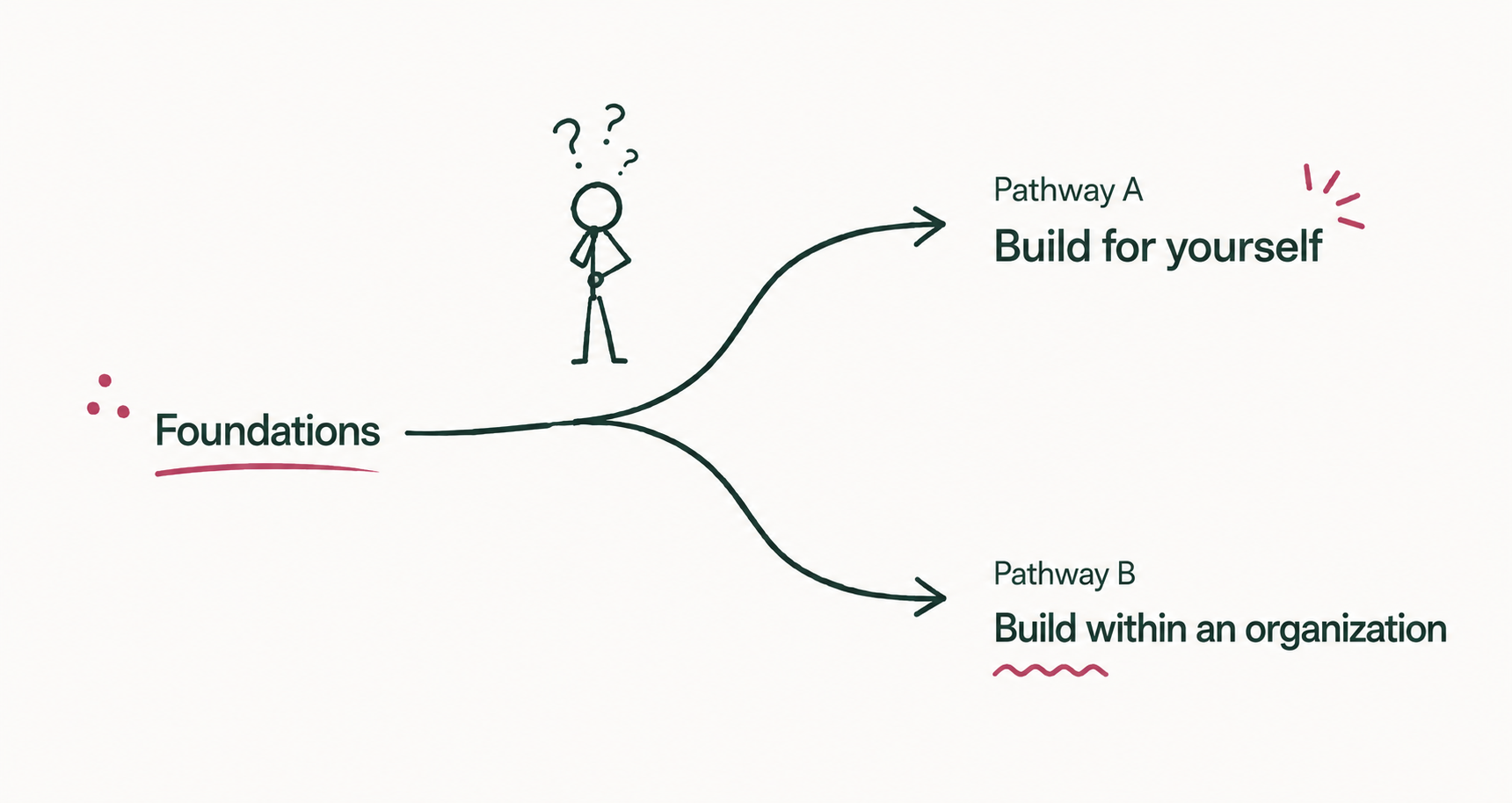
Leveling Up with AIMove from individual AI tasks to repeatable workflows, useful tools and thoughtful organizational practices.Shared foundation · Two pathwaysView overviewHide overview+
Using AI Safely and ResponsiblyMake informed choices about privacy, accuracy, ownership, wellbeing and AI’s wider effects.5 coursesView coursesHide courses+
Using AI responsibly involves more than following a list of warnings. This program helps you recognize risks, understand trade-offs and make choices you can explain and defend.
Some courses focus on practical protection and verification. Others create space to examine how AI affects people, communities and the environment.
Course 4.1
Protecting Your Privacy and Identity
Learn what to keep out of AI tools, what can reveal more than you expect and what to do if sensitive information is shared accidentally.
You’ll learn to:
Recognize personal, confidential and identifying information
Remove or disguise identifying details and hidden file information
Choose tools and accounts appropriate to the information involved
Typical duration1 hour
Course 4.2
Checking Facts, Fakes and Scams
Learn how to verify AI-generated information and respond to increasingly convincing forms of deception.
You’ll learn to:
Identify claims, sources and media that require verification
Trace important information back to reliable original sources
Recognize AI-enabled scams, impersonation and misleading content
Typical duration1 hour
Course 4.3
Copyright, Ownership and Consent
Understand what you may upload, adapt, publish or share—and when permission, attribution or further guidance is needed.
You’ll learn to:
Distinguish copyright, ownership, permission and attribution
Assess whether material can be uploaded to or reused from an AI tool
Obtain consent and give appropriate credit
Typical duration1 hour
Course 4.4
How AI Affects the Way We Think and Feel
Examine how AI can influence understanding, confidence, creativity, emotional connection and everyday habits.
You’ll explore how to:
Distinguish useful support from handing over your thinking
Preserve your own knowledge, judgment, skills and voice
Set healthy boundaries for cognitive and emotional uses of AI
Typical duration1 hour
Course 4.5
The Bigger Picture—AI, People and the Planet
Look beyond the individual user to consider who benefits from AI, who may be disadvantaged and what resources AI systems require.
You’ll explore:
Bias, accessibility, exclusion and AI-supported decisions
Hidden labour and the effects of AI on people’s work and control
Environmental costs and when a simpler option may meet the need
Protecting Your Credibility When Using AIProduce work you can stand behind and preserve trust when AI contributes to the process.5 coursesView coursesHide courses+
AI can help people produce more work, more quickly—but speed and polish do not guarantee understanding, quality or responsibility.
This program examines the questions that arise after AI becomes part of everyday work: Can I stand behind the result? Should I disclose AI use? What should I ask of others? Is the work genuinely good? What is AI use doing to trust?
Some familiarity with everyday AI tasks is helpful.
Course 5.1
Taking Accountability for AI-Assisted Work
Build a workable process for supervising AI output and taking responsibility for the final result.
You’ll learn to:
Decide what can be delegated and what requires human involvement
Match the level of review to the consequences of an error
Create review points and keep useful records of important decisions
Typical duration1 hour
Course 5.2
When to Say You Used AI
Decide when disclosure is appropriate and explain AI’s contribution without making the disclosure vague, defensive or excessive.
You’ll learn to:
Distinguish minor assistance from substantial AI contribution
Recognize when nondisclosure would create a false impression
Write clear, proportionate AI-use statements
Typical duration1 hour
Course 5.3
Asking About AI-Assisted Work
Ask useful questions when a colleague, contractor, vendor or supplier gives you work that may involve AI.
You’ll learn to:
Ask how AI was used and who reviewed and approved the work
Request appropriate sources, records and process evidence
Judge whether the level of human oversight was sufficient
Typical duration1 hour
Course 5.4
Ensuring High Quality in AI-Assisted Work
Move beyond competent-looking output and produce work that is useful, specific and worth someone else’s attention.
You’ll learn to:
Recognize repetition, filler, vague claims and empty polish
Replace generic content with evidence, reasoning and judgment
Preserve meaningful voice, originality and professional standards
Typical duration1 hour
Course 5.5
AI Use and Human Trust
Examine what happens when people can no longer tell how much human thought, effort or attention is behind a piece of work or communication.
You’ll explore:
When people reasonably expect direct human involvement
How undisclosed or excessive AI use can weaken trust
How teams can make AI use discussable without suspicion or shame